Skip to content
Psychology Connections
  • Psychology
    • Personality Psychology
    • Relationships
    • Cognitive Psychology
    • Behavioral Psychology
    • Emotions
    • Social Psychology
    • Attachment Psychology
  • Quizzes & Tests
    • Personality Quizzes
    • Emotional Intelligence Tests
    • Psychology Tests
    • Relationship Quizzes
  • Books
    • Best Psychology Books
    • Book Reviews
    • Book Summaries
  • Dictionary
    • Concepts
    • Terms
    • Theories & Models
  • About
  • Contact

Relationships

Illustration of a single abstract figure with warm light nearby, captioned 'loneliness is perceived isolation — not being alone'

Loneliness: What Psychology Knows

Loneliness is one of the most misunderstood human experiences. It is not the same as being alone — you can …

Read More →

Illustration of two abstract figures connected by an arc, captioned 'how friendships form — and why they last'

The Psychology of Friendship

Friendship gets far less scientific attention than romantic love, which is strange when you consider how much of life runs …
Read More →

Illustration of a heart with golden seams mending a crack, captioned 'heartbreak hurts — and healing is a process'

Why Breakups Hurt: The Psychology of Heartbreak and Recovery

Breakups hurt so much because a romantic partner is never just one thing in your life. They are an attachment …
Read More →

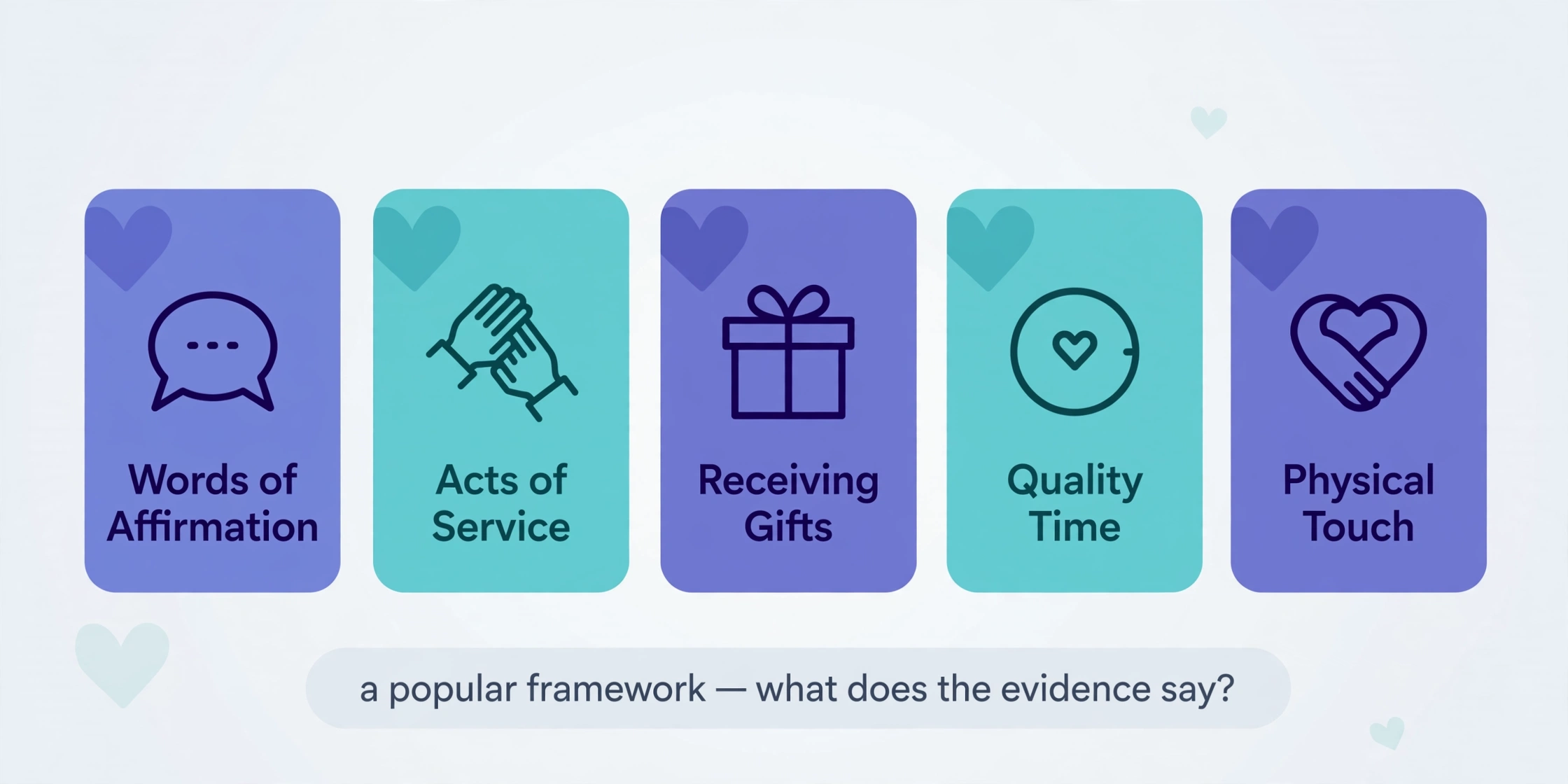
Diagram of the five love languages: words of affirmation, acts of service, receiving gifts, quality time, and physical touch, captioned 'a popular framework — what does the evidence say?'

Love Languages: What They Are and What Research Says

The five love languages — words of affirmation, acts of service, receiving gifts, quality time, and physical touch — come …
Read More →

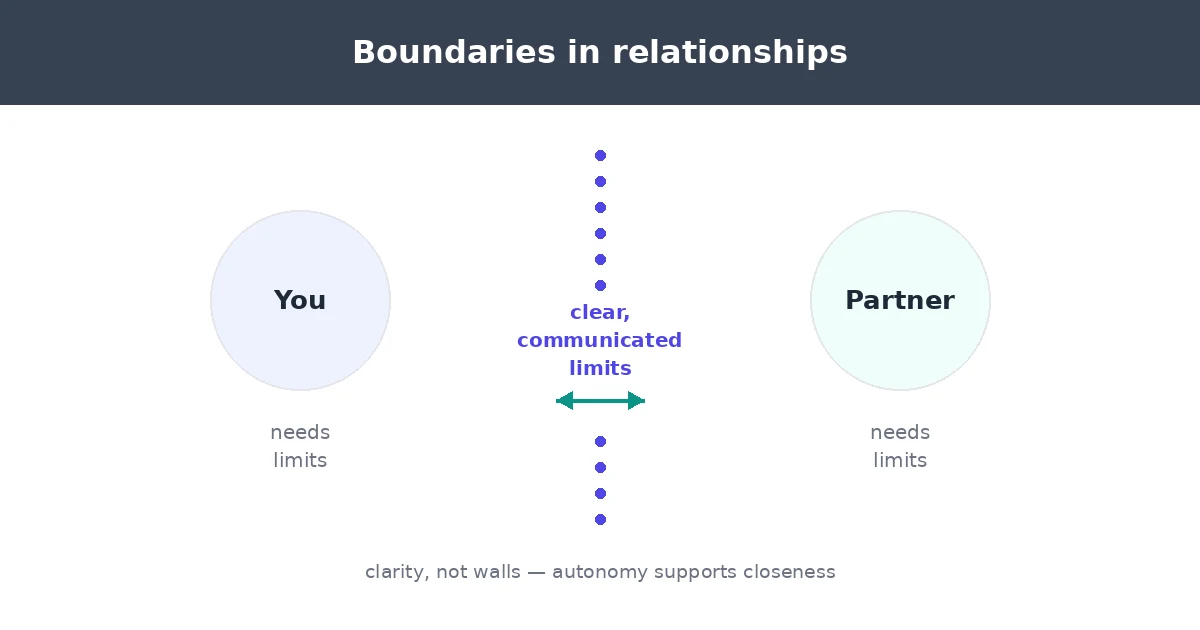
Diagram illustrating healthy boundaries in a relationship: two partners labeled 'You' and 'Partner,' each with needs and limits, separated by a permeable dotted boundary marked 'clear, communicated limits' with two-way arrows

Boundaries in Relationships: What They Are and How They Work

Boundaries in a relationship are clear, communicated understandings about each person’s needs, limits, and expectations — covering everything from alone …
Read More →

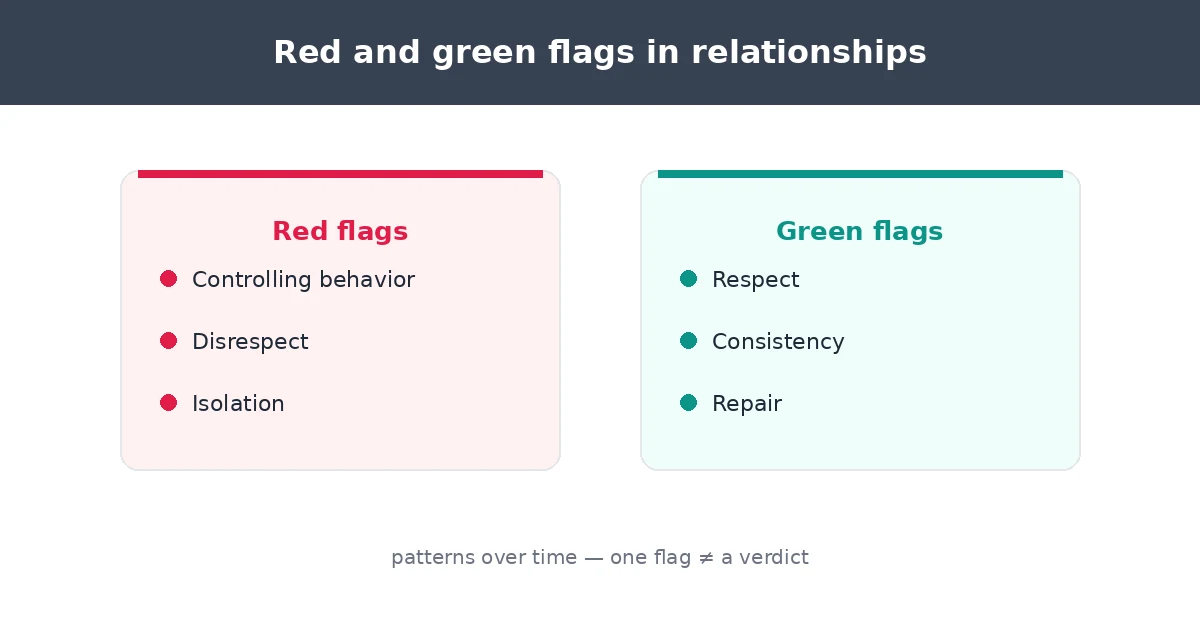
Diagram of relationship red flags and green flags: a rose card listing Controlling behavior, Disrespect, and Isolation beside a teal card listing Respect, Consistency, and Repair, captioned 'patterns over time — one flag is not a verdict'

Green and Red Flags in Relationships: Patterns Worth Noticing

Red flags in a relationship are recurring patterns — not single bad days — that show how someone tends to …
Read More →

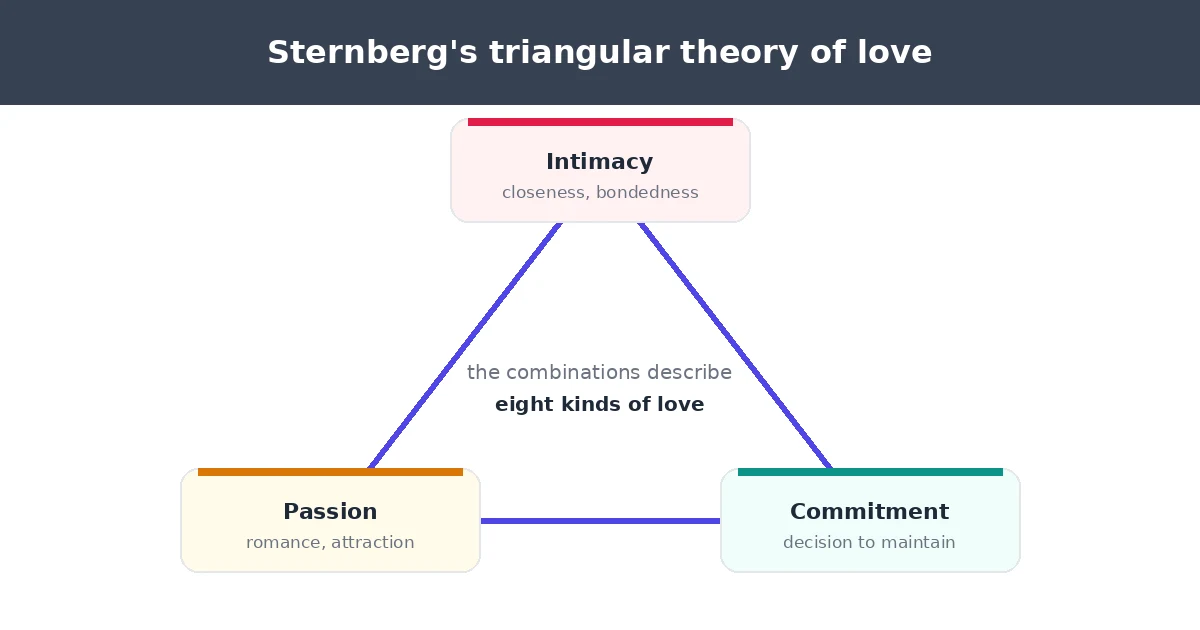
Diagram of Sternberg's triangular theory of love: a triangle with vertices labeled intimacy, passion, and commitment

Sternberg’s Triangular Theory of Love: Intimacy, Passion, Commitment

Robert Sternberg’s triangular theory of love (1986) proposes that love has three components: intimacy (closeness and connectedness), passion (romance, attraction, …
Read More →

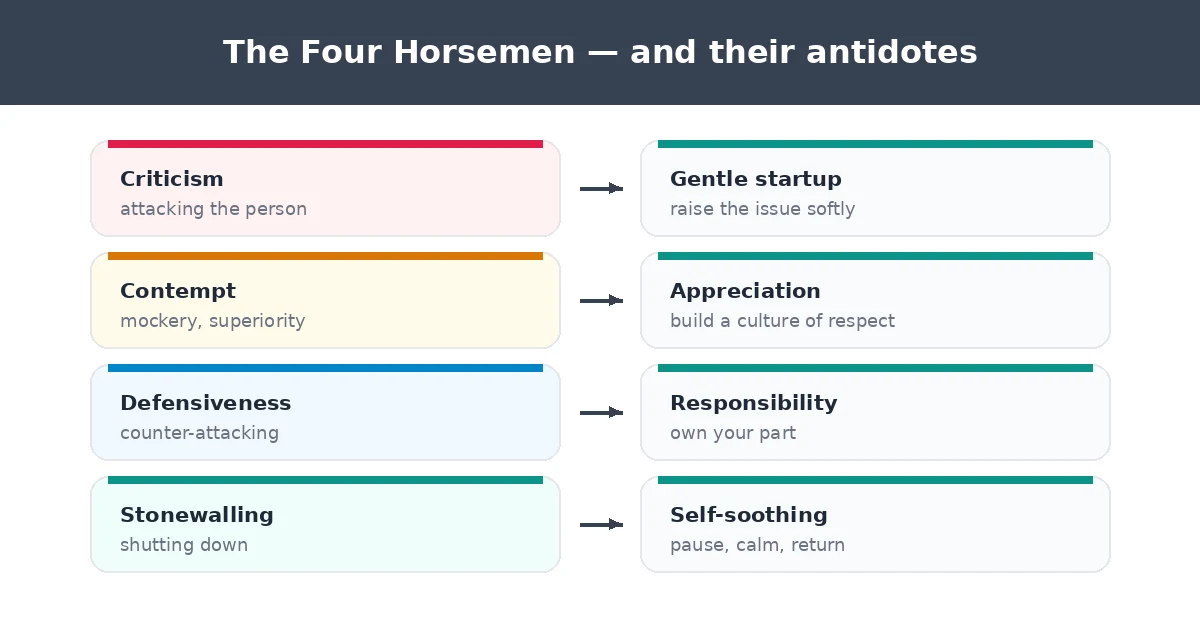
Diagram of Gottman's Four Horsemen — criticism, contempt, defensiveness, and stonewalling — each paired with its antidote: gentle startup, culture of appreciation, taking responsibility, and self-soothing breaks

Conflict in Relationships: How Healthy Couples Handle Disagreements

Disagreements don’t predict whether a relationship lasts — research consistently finds it’s not how often couples fight, but how. Couples …
Read More →

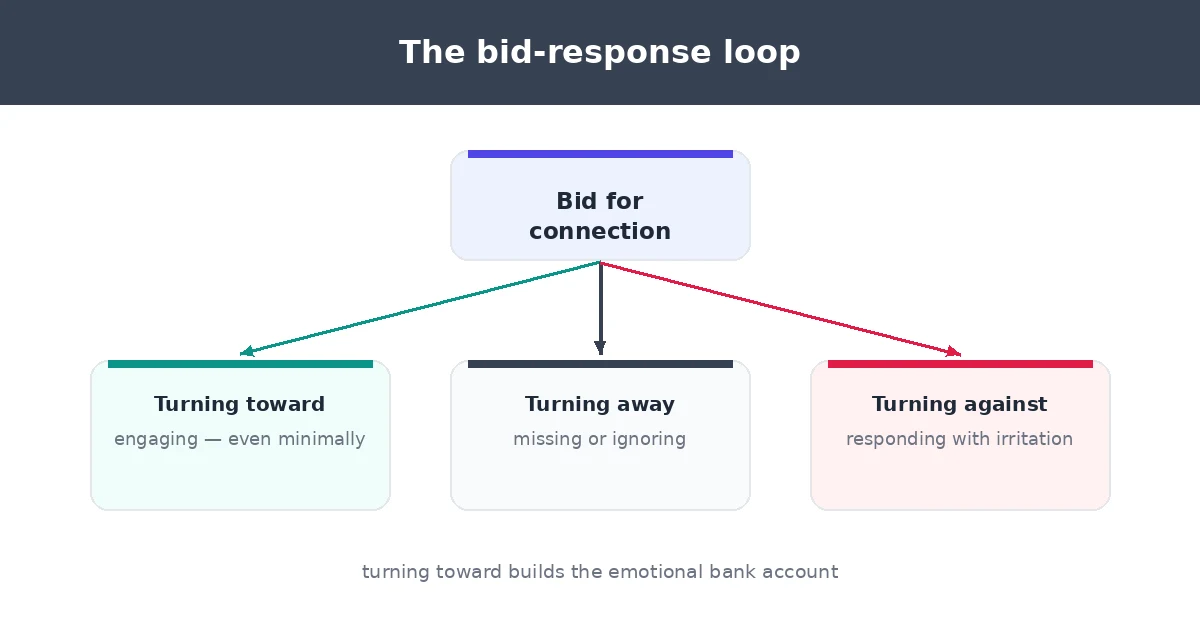
Diagram of the bid-response loop in relationships: a partner's bid for connection branches into turning toward (engagement), turning away (ignored), and turning against (irritation).

Communication in Relationships: What Research Says Works

Research distinguishes couples less by whether they disagree than by how they talk: the balance of positive to negative moments …
Read More →

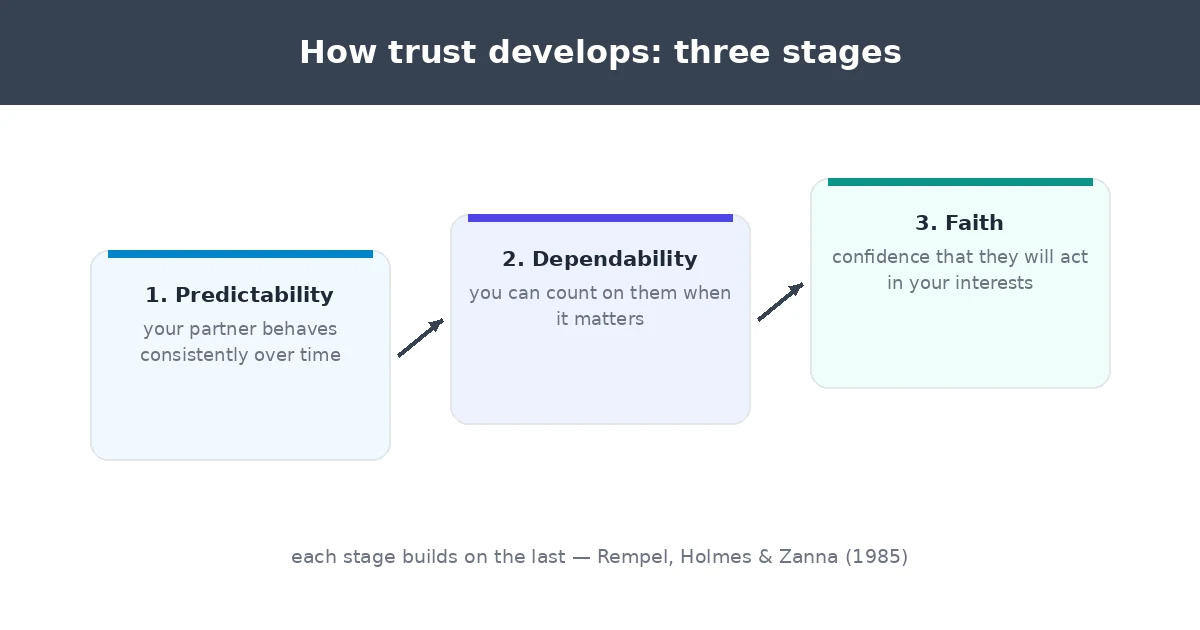
Staircase diagram showing the three stages of trust in relationships: predictability, then dependability, then faith

Trust in Relationships: How It’s Built and Repaired

Trust is the expectation that your partner will act in your best interests — especially when it counts. Psychologists Rempel, …

Read More →

Older posts
Newer posts
← Previous Page1 Page2 Page3 Next →

Recent Posts

  • Abstract diagram of a single figure standing apart from a crowd, illustrating the bystander effectBystander Effect
  • Abstract diagram of an anchor tied to a measuring scale, illustrating anchoringAnchoring
  • Abstract diagram of a lamp casting distorted wavy shadows of simple shapes, illustrating gaslightingGaslighting
  • Abstract diagram of a figure resting on flowing waves, illustrating flowFlow
  • Abstract diagram of a figure sitting inside an open enclosure beside an open path, illustrating learned helplessnessLearned Helplessness
  • Abstract diagram of a faint star outline becoming a bright solid star, illustrating primingPriming
  • About
  • Contact
  • Privacy Policy
  • Terms of Service
  • Disclaimer
© 2026 psychologyconnections All Rights Reserved.