
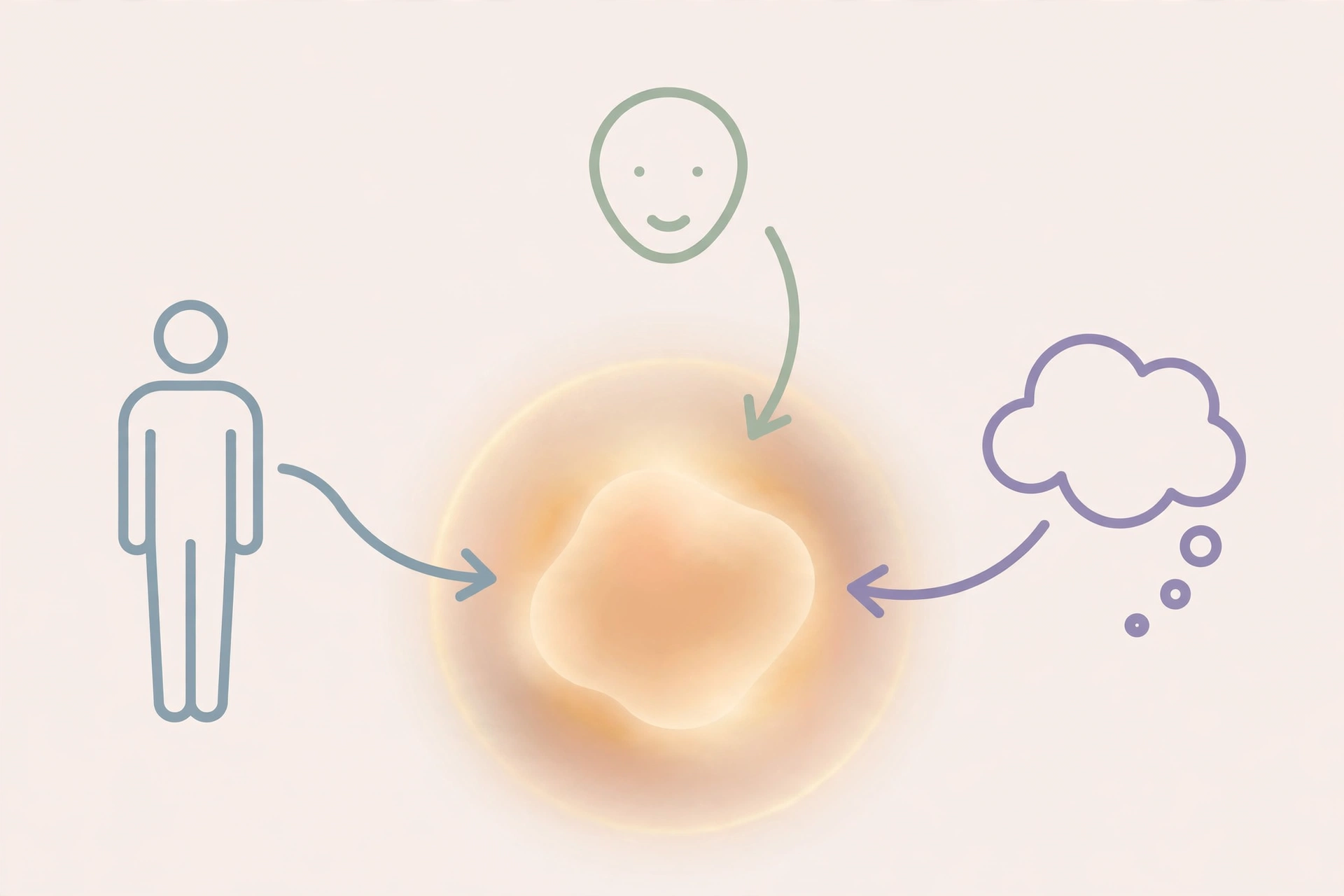
An emotion is a short, coordinated response to something that matters to you: a situation is appraised as relevant to your goals, and your body, attention, expression, and action tendencies shift together, briefly, to deal with it. Fear prepares you to escape or freeze; anger prepares you to confront an obstacle; joy signals that something good is happening and worth continuing. Emotions are not the opposite of reason. They are information — fast, embodied signals about what is at stake — and much of psychology is the study of how those signals arise, what they do, and when they mislead.
This article is educational, not clinical. It explains what emotions are, why they exist, and how the major theories account for them. It is not therapy and not a treatment guide: if emotions are causing serious distress or interfering with daily life, that is a matter for a qualified professional, not for a summary of emotion science.
What Is an Emotion?
Psychologists distinguish emotions from the broader family of affective states. In his argument for basic emotions, Paul Ekman (1992) listed features that mark emotions out: rapid onset, short duration, unbidden occurrence, automatic appraisal, and coherence among responses — the feeling, the bodily change, and the expressio/n hang together. A mood, by contrast, lasts longer and often has no clear trigger. An attitude is an evaluation that can persist for years. An emotion is an episode: it starts, peaks, and passes.
That episodic character matters because it explains why emotions feel both powerful and temporary. A surge of anger at an insult is intense for minutes, not days — unless it is refreshed by rumination, which is a different process. The same logic applies to joy, disgust, and fear. When people say they are “an emotional person,” they usually mean their episodes are frequent or intense, not that they are in a permanent emotional state.
Emotions also have components that can come apart. You can feel afraid without showing it, show a smile without feeling happy, or have a racing heart from coffee rather than fear. The psychology of emotions is largely the study of how these components — feeling, bodily arousal, expression, and appraisal — relate to one another, and why they sometimes disagree.
The Body in Emotion
The oldest scientific debate about emotion concerns the body’s role. William James (1884) proposed a radical reversal of common sense: we do not tremble because we are afraid; rather, we feel afraid because we tremble. In his view, the perception of bodily changes — a racing heart, tense muscles, a sinking stomach — is itself the emotion. The Danish physiologist Carl Lange independently reached a similar conclusion (Lange, 1885), which is why the view is called the James-Lange theory.
Walter Cannon (1927) attacked that theory on several grounds. He argued that bodily changes are too slow and too similar across emotions to explain the variety of feelings: the same racing heart accompanies fear, anger, and excitement, so the body alone cannot tell them apart. He also pointed to evidence that emotions could occur even when bodily feedback was reduced. Cannon’s alternative — that the brain generates the feeling and the bodily response at the same time — became the Cannon-Bard theory.
Modern evidence has softened both extremes. Bodily feedback does shape feeling — experiments on facial feedback show that adopting an expression can nudge experience — but it does not determine it alone. The body contributes information; the brain interprets it in context. Neither James nor Cannon was entirely right, and both identified a real piece of the puzzle.
Why Emotions Exist: What They Do
Emotions evolved because they solve problems. Fear mobilizes the body for threat; disgust protects against contamination; sadness after a loss slows activity and signals a need for support; anger organizes effort against an obstacle. Robert Plutchik (1980) developed this functional view systematically, treating each emotion as an evolved response to a recurring survival problem, with opposites (joy versus sadness, trust versus disgust) arranged in a structured model.
Emotions also do social work. A facial expression of fear alerts others to danger; a display of sadness invites help; an expression of anger warns others to back off. This communicative function is why expressions are studied so closely: they are not just private feelings leaking out, but signals that coordinate groups. That is also why display rules differ across cultures — people learn when to amplify, soften, or hide expressions, even when the underlying feeling is similar.
A third function is decision-making. Emotions mark options with value before slow deliberation finishes. The unease you feel about a risky choice, or the warmth you feel toward a trusted person, is information your brain has computed from past experience. Treating emotions as noise to be ignored misses this: they are often the fastest summary of what you have learned, even when they need checking against the facts.
The Major Theories at a Glance
No single theory explains emotion fully, and the field’s history is a sequence of corrections. The James-Lange theory made the body central (James, 1884). Cannon (1927) objected that bodily changes are too undifferentiated, and proposed parallel brain pathways for feeling and bodily response. Schachter and Singer (1962) added cognition: they argued that an emotional state is a function of physiological arousal plus a cognitive label for that arousal, and their epinephrine experiment showed that the same arousal could be experienced as euphoria or anger depending on the available explanation.
Later theories added appraisal — the idea that emotions depend on how a situation is evaluated for personal relevance. Richard Lazarus (1991) developed this view most fully, arguing that different appraisals (Is this a loss? A threat? An offense?) produce different emotions. More recently, Lisa Feldman Barrett (2017) has argued that emotions are constructed in the moment: the brain predicts, using past experience and concepts learned from culture, and the resulting category — “anger,” “fear,” “joy” — is an act of construction rather than the triggering of a fixed circuit.
These theories disagree about what is universal and what is learned, about how much the body matters, and about whether emotions are natural kinds or constructed categories. That disagreement is productive: each theory explains some findings well and others poorly, and the field advances by testing where each one breaks.
Emotions in Everyday Life
Emotion science shows up in ordinary decisions. When you rehearse a difficult conversation, you are doing emotion regulation — changing the situation, your attention, or your interpretation before the feeling peaks. When a song brings back a summer, that is an association formed the way classical conditioning forms any association. When you misread a colleague’s neutral face as hostile, that is your appraisal system filling in gaps with your current concerns.
It also explains common mistakes. People routinely overestimate how long a feeling will last, which is why a bad day feels permanent and a good purchase feels like lasting happiness. People confuse arousal with a specific emotion — mistaking nervousness for dislike, or excitement for attraction — because the body’s signal is genuinely ambiguous. And people treat the intensity of a feeling as evidence for the truth of the belief behind it, when intensity mostly measures how much is at stake, not how accurate the appraisal is.
Understanding these patterns does not remove feelings, and it should not. The point is leverage: knowing that an emotion is an episode, not a verdict, makes it easier to wait, check the facts, and choose a response rather than being carried by the first surge. For how these abilities are measured and where people differ, see the follow-up on emotional intelligence.
What Emotions Are Not
Emotions are not commands. Feeling angry does not oblige you to act angrily, and feeling afraid does not mean a situation is dangerous. They are not diagnoses either: feeling sad is not the same as a depressive disorder, and feeling anxious is not the same as an anxiety disorder. Duration, impairment, and context are what turn an ordinary emotional episode into a clinical concern, and that judgment belongs to professionals.
Emotions are also not purely private. They are shaped by language, culture, and relationships — by the emotion words your language gives you, by your family’s display rules, and by the situations your life repeatedly presents. Two people can face the same event and feel differently, not because one is irrational, but because their appraisals, histories, and bodily states differ. That variability is normal, not a flaw in the system.
Key Takeaways
- An emotion is a brief, coordinated response to something personally relevant, with feeling, bodily change, expression, and action tendency shifting together.
- Emotions differ from moods (longer, often triggerless) and attitudes (lasting evaluations); they are episodes that start, peak, and pass (Ekman, 1992).
- The body contributes to emotion but does not determine it alone — the James-Lange emphasis on bodily feedback and Cannon’s (1927) critique both capture part of the truth.
- Schachter and Singer (1962) showed that arousal plus a cognitive label shapes which emotion is experienced.
- Emotions serve functions: they prepare action, communicate to others, and summarize learned value for decisions (Plutchik, 1980).
- Appraisal theories (Lazarus, 1991) and constructed-emotion theory (Barrett, 2017) disagree about universality and mechanism — and that debate is still active.
- Feelings are information, not verdicts: intensity measures what is at stake, not whether an appraisal is accurate.
References
- Barrett, L. F. (2017). How Emotions Are Made: The Secret Life of the Brain. Houghton Mifflin Harcourt.
- Cannon, W. B. (1927). The James-Lange theory of emotions: A critical examination and an alternative theory. The American Journal of Psychology, 39(1/4), 106–124. https://doi.org/10.2307/1415404
- Ekman, P. (1992). An argument for basic emotions. Cognition and Emotion, 6(3–4), 169–200. https://doi.org/10.1080/02699939208411068
- Gross, J. J. (1998). The emerging field of emotion regulation: An integrative review. Review of General Psychology, 2(3), 271–299. https://doi.org/10.1037/1089-2680.2.3.271
- James, W. (1884). What is an emotion? Mind, 9(34), 188–205. https://doi.org/10.1093/mind/os-IX.34.188
- Lange, C. (1885). Om sindsbevaegelser: Et psyko-fysiologisk studie. Jacob Lunds.
- Lazarus, R. S. (1991). Emotion and Adaptation. Oxford University Press.
- Plutchik, R. (1980). Emotion: A Psychoevolutionary Synthesis. Harper & Row.
- Schachter, S., & Singer, J. (1962). Cognitive, social, and physiological determinants of emotional state. Psychological Review, 69(5), 379–399. https://doi.org/10.1037/h0046234
Keep Exploring
- What Is Personality Psychology?
- Theories of Personality
- Cognitive Biases: How Your Mind Takes Shortcuts
- Behavioral Psychology: How Learning Shapes Behavior
- Loneliness: What Psychology Knows
- The Psychology of Jealousy
What is the psychology of emotions?
It is the study of how emotions arise, what they consist of (feeling, bodily change, expression, appraisal), what they do, and how they can be managed — drawing on physiology, cognition, development, and culture.
What is an emotion in simple terms?
A brief, coordinated response to something that matters to you: your body, attention, expression, and urge to act shift together for a short time to deal with a situation.
Are emotions universal?
Partly. Some patterns — like the link between certain situations and certain feelings, and the broad recognition of some facial expressions — appear across cultures, but the details vary with language, learning, and display rules.
Do emotions come from the body or the brain?
Both. Bodily feedback shapes feeling, as James (1884) argued, but the brain’s interpretation in context matters too, as Cannon (1927) and later appraisal and construction theories showed.
Can you control your emotions?
You cannot usually prevent an emotion from arising, but you can influence it — by changing the situation, your attention, your interpretation, or your response — which is the subject of emotion regulation research (Gross, 1998).